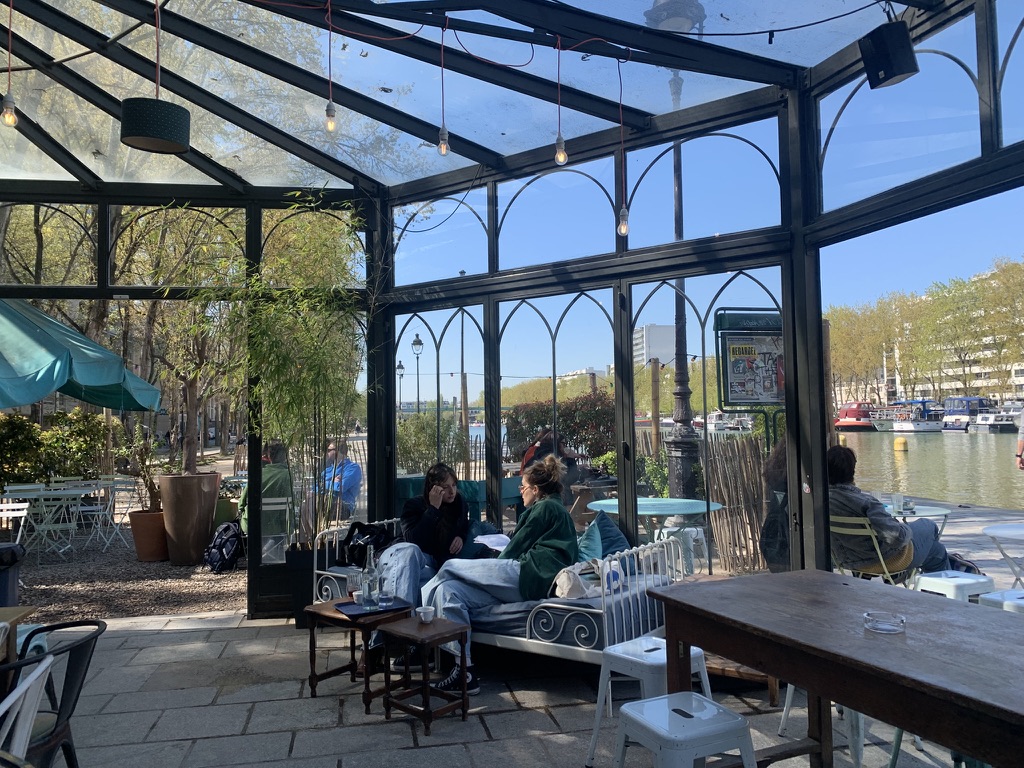
The barometric pressure fell in Paris today after a flamboyantly long run of good weather. But this morning, it became Paris again–grey, rainy and humid. Not waking up in the best frame of mind, I ended up joining a very long line at Le Pavillon des Canaux. It was the kind of line where you filled the time being lost in thoughts of getting out of that line, even as it slowly inched towards a reward in the shape of infinite regret (kind of like salaried work).
Now don’t get me wrong, I love the Pavillon des Canaux, it is a bit kitsch, but still very cool–it is like the girl who wears such obvious color palettes but does so with such panache and commitment that her style works somehow. You get tired of David Bowie playing in the background, and there is always a swarm of English speakers spilling in from St. Christopher’s Inn the club-hostel cauldron of youth nearby. But during the warm weather, the side terrace creates such a sunny cocoon, with the gleaming water of the canal on one side, the green of spring over you, the panorama of trees ahead.

The seductiveness of this “outdoor area” is why Le Pavillon des Canaux, which grew out of an urban renewal project, now charges 21 to 31 € for its “uniquement formules” brunch over the weekend. Many people on Google reviews say that “the food is really good.” I do not get these people. Imagine if you had a friend who works for an NGO (or ONG as they say here), who is vegetarian and “likes to cook”–she inevitably, but lovingly, prepares some under-seasoned cauliflowers warmed in the oven with a dash of olive oil, which she serves on colorful ceramic ware that she bought in Marrakech and everyone says it is really good. The food at Le Pavillon des Canaux is good in the same way. Meaning it is not that great, but the sense of time and labor over non-GMO ingredients seduces you into thinking that you are eating something good, because young privileged white people spent time making it, time that they could be using to listen to podcasts about the feminism of such-and-such songwriters on public radio.
Now back to the line. I am in line, the line moves very slowly. In front of me is an insufferable French couple in their 30s. The man is clean shaven and very boring in an impeccable wool sweater and I can see into the vista the well-placed plants in their apartment, an apartment which is probably replete with a nice kitchen and an under-nourished sex life. Of course all of this could be my judgey fantasy because as I told you, the barometric pressure fell. The woman’s face is set in a hard permanent frown as though she were wearing a classical masque called Le Cynisme. They seemed so unhappy and they were in this line on a Saturday where the clouds were piling up in the sky, to get this brunch to punctuate their coupled life with an activity over the weekend. Meanwhile, the young Americans behind me looked more French than the actual French people, which young Americans in the area tend to–they have studied the semiotics of French style and from an insecure distance, have usually managed to simulate it to a much higher precision than the natives. A young girl drew my attention with her black t-shirt and long black hair, pale skin, green eyes accentuated by good mascara. As soon as she spoke, the illusion was shattered. She was not interesting, she just simulated the surface of interesting characters in films you’ve seen, perhaps not unlike the decor of Le Pavillon des Canaux.
Where was I as I stood in this line? I was caught between the life that I was in with all its shoddy judgments about people and the promise of scones and the terrace outside–which would bring exactly what to my life? There were two formules, one was a plat, and a side, with a jus maison of choice (bissap, or ginger lemonade) and endless refill of tea and coffee (what endless potential of my life could I realize with this endless refill of coffee and tea?). The other formule consisted of two plats, a side, a dessert and the same drinks. Now for 21 €, I got a scone with a side of potatoes. Let us talk about the scone, which seduced me in its chalkboard description, and which seduced me in the quick flash I saw of it on the trays that people carried to the tables outside. The scone on someone else’s plate that you catch a quick glimpse of, is always more interesting than the scone on the plate in front of you that you paid for. I had read the petit description, where I was told that the scone, would be filled inside with some dollop of creme fraîche, and parmesan and, lemon. Like every reluctant consumer, I thought about how I could go to Monoprix to buy a scone and put some creamy stuff inside and serve it on a plate inside my house, but instead I stood in line and waited some more. Perhaps it is because I have passed by this place for so many weekends and have not gotten the brunch formule and perhaps for once, I wanted to say to hell with it and overspend in the thick of despair during a weekend, and get this brunch.
When the food came, the scone was terribly disappointing. Dry, and that sole wedge of lemon inside, felt incredibly ideological. It was for this wedge of lemon crushed into the dry scone amidst some dollop of cream that I paid 21 euros. Why did that lemon slice work so effectively to sell the whole brunch? I took the huge plastic tray outside, sat at a table in the heavy air, and tried to read some Janet Malcolm, regretting the potatoes, regretting the scone, regretting the watery café filtre and trying to make peace with the fact that it was another wasted Saturday. Which I guess is the point of brunch, we are all dry scones injected with a dollop of cream.
 A Grumpy New Yorker in Paris
Leave a comment